 TM
Mild and earthy. Always cooked.
Taro: a root worth knowing
Taro is a starchy root vegetable, technically a corm, with a mild, earthy flavor. It must always be cooked, because raw taro irritates the mouth and throat. Once cooked it turns tender and creamy, and when baked or fried it crisps up well, which makes it a natural fit for fries and crunchy bites.
Quick facts
- Plant
- Colocasia esculenta, in the arum family
- Part eaten
- The underground corm (the leaves are also eaten, cooked)
- Flavor
- Mild and earthy
- Usually eaten
- Cooked only (boiled, baked, fried, steamed)
- Where it is grown
- Tropical and subtropical regions, including Pacific islands, Asia, Africa and the Caribbean
Where taro comes from
Taro is one of the oldest cultivated crops in the world. It is believed to come from Southeast Asia, and researchers estimate it was first cultivated somewhere between 9,000 and 10,000 years ago.
It spread across Asia and, carried by seafaring peoples, throughout the Pacific islands, where it became a cornerstone food and a cultural symbol. In Hawaii it is called kalo, and the pounded corm becomes poi. Taro also reached Africa and the Caribbean, where it is grown today.
Taro vs. potato, yam, sweet potato and cassava
Several starchy roots get mixed up in the grocery aisle. They are different plants with different flavors and textures.
| Plant | Typical flavor | |
|---|---|---|
| Taro | Colocasia esculenta (corm) | Mild and earthy |
| Potato | Solanum tuberosum (tuber) | Neutral and savory |
| Sweet potato | Ipomoea batatas (root) | Sweet |
| Cassava | Manihot esculenta (root) | Mild and starchy |
Taro at a glance
Approximate values per 100 g of raw taro. They change with variety and growing conditions.
| Energy | about 112 kcal |
|---|---|
| Carbohydrate | about 26 g |
| Dietary fiber | about 4 g |
| Potassium | about 590 mg |
| Vitamin C | about 5 mg |
Source: USDA FoodData Central, "Taro, raw".
What the research says
Taro is mostly starch, and it contains dietary fiber and potassium, along with smaller amounts of other minerals. Reviews also describe plant compounds such as polyphenols and, in purple varieties, anthocyanins.
Raw taro contains needle-shaped calcium oxalate crystals that irritate the mouth and throat. Cooking, and in some traditions soaking or fermenting, reduces them, which is why taro is always cooked.
Snub does not make health claims about taro; we share what it is and how we use it.
Myths worth dropping
"Taro is the same as yam or sweet potato."
They are different plants. Taro is a corm with a mild, earthy flavor, not a sweet root like sweet potato.
"Taro is poisonous."
Only when it is raw. Raw taro irritates the mouth and throat, and cooked taro is a staple food for millions of people.
"The purple flecks mean it is spoiled."
Many taro varieties have natural purple or pink flecks. They are part of the root, not a sign of spoilage.
"Taro is only a Pacific food."
Taro began in Southeast Asia and is grown across Asia, Africa, the Caribbean and the Pacific. Hawaii's kalo is one famous tradition among many.
How we use taro
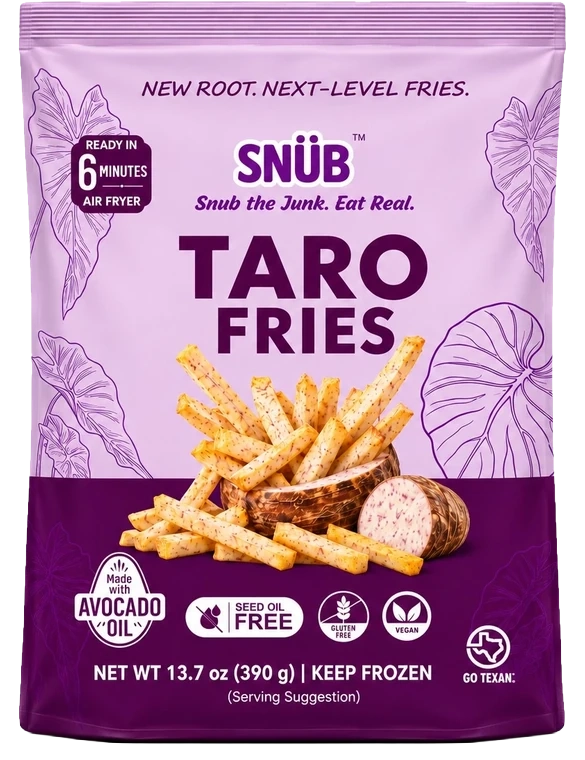
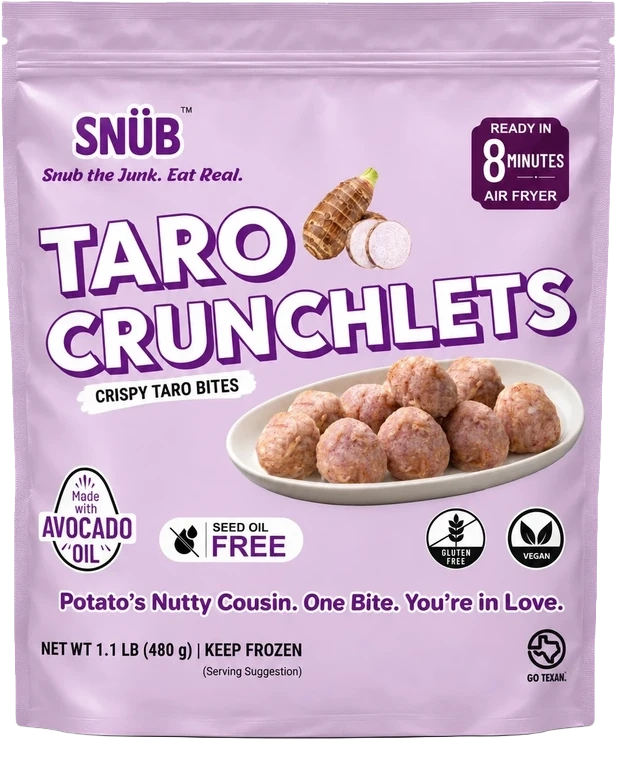
We use taro for its mild, earthy flavor and starchy texture. It becomes our Taro Crunchlets and Taro Fries, crisp outside and tender inside.
Ways to enjoy it
- Air-fry taro fries until golden and serve with a bright, tangy dip.
- Pair taro crunchlets with creamy dips like guacamole or yogurt sauce.
- Try a half-and-half basket of taro and plantain fries to taste the difference.
Taro questions, answered
What is taro?
Taro is a starchy root vegetable, a corm of the plant Colocasia esculenta. It has a mild, earthy flavor and is always eaten cooked.
What does taro taste like?
Mild and earthy, with a creamy texture when cooked. It is not sweet like sweet potato.
Can you eat taro raw?
No. Raw taro contains calcium oxalate crystals that irritate the mouth and throat. Always cook it.
Is taro the same as yam?
No. Taro, yam and sweet potato are different plants with different flavors and textures.
Why does taro have purple flecks?
Many varieties have natural purple or pink flecks. They are normal pigments, not a sign that the root has spoiled.
Is taro gluten-free?
Taro is a root vegetable, and whole taro is naturally gluten-free. Always check the label on any prepared product for how it was made.